
GLM-OCR: 0.9B Parameters Achieving OCR SOTA Performance
Introducing GLM-OCR, a lightweight professional OCR model with only 0.9B parameters that achieves state-of-the-art performance on OmniDocBench V1.5 with a score of 94.62.
Introduction
GLM-OCR is a lightweight professional OCR model with parameters as small as 0.9B, yet it achieves state-of-the-art performance across multiple capabilities. It sets a new benchmark for document parsing with its "small size and high accuracy."
Key Features
State-of-the-Art Performance
GLM-OCR scored 94.62 points to top OmniDocBench V1.5 and achieved current best performance across multiple mainstream document understanding benchmarks including:
- Text Recognition
- Table Recognition
- Formula Recognition
- Information Extraction
Optimized for Real-World Scenarios
GLM-OCR delivers stable, leading accuracy in complex environments like:
- Code documentation
- Intricate tables with merged cells
- Stamp/seal recognition
- Handwriting recognition
- Multilingual text processing
Efficient and Cost-Effective
With just 0.9B parameters, GLM-OCR supports multiple deployment options:
- vLLM for high-performance inference
- SGLang for efficient serving
- Ollama for local deployment
This significantly reduces inference latency and computational overhead, making it approximately 1/10 the cost of traditional OCR solutions.
Technical Architecture
GLM-OCR is built on the GLM-V encoder-decoder architecture, integrating:
- CogViT Visual Encoder: Pre-trained on large-scale image-text data
- Lightweight Cross-Modal Connector: Efficient token downsampling
- GLM-0.5B Language Decoder: Powerful language understanding
Performance Benchmarks
GLM-OCR outperforms specialized OCR models and approaches general large models like Gemini-3-Pro across multiple benchmarks:
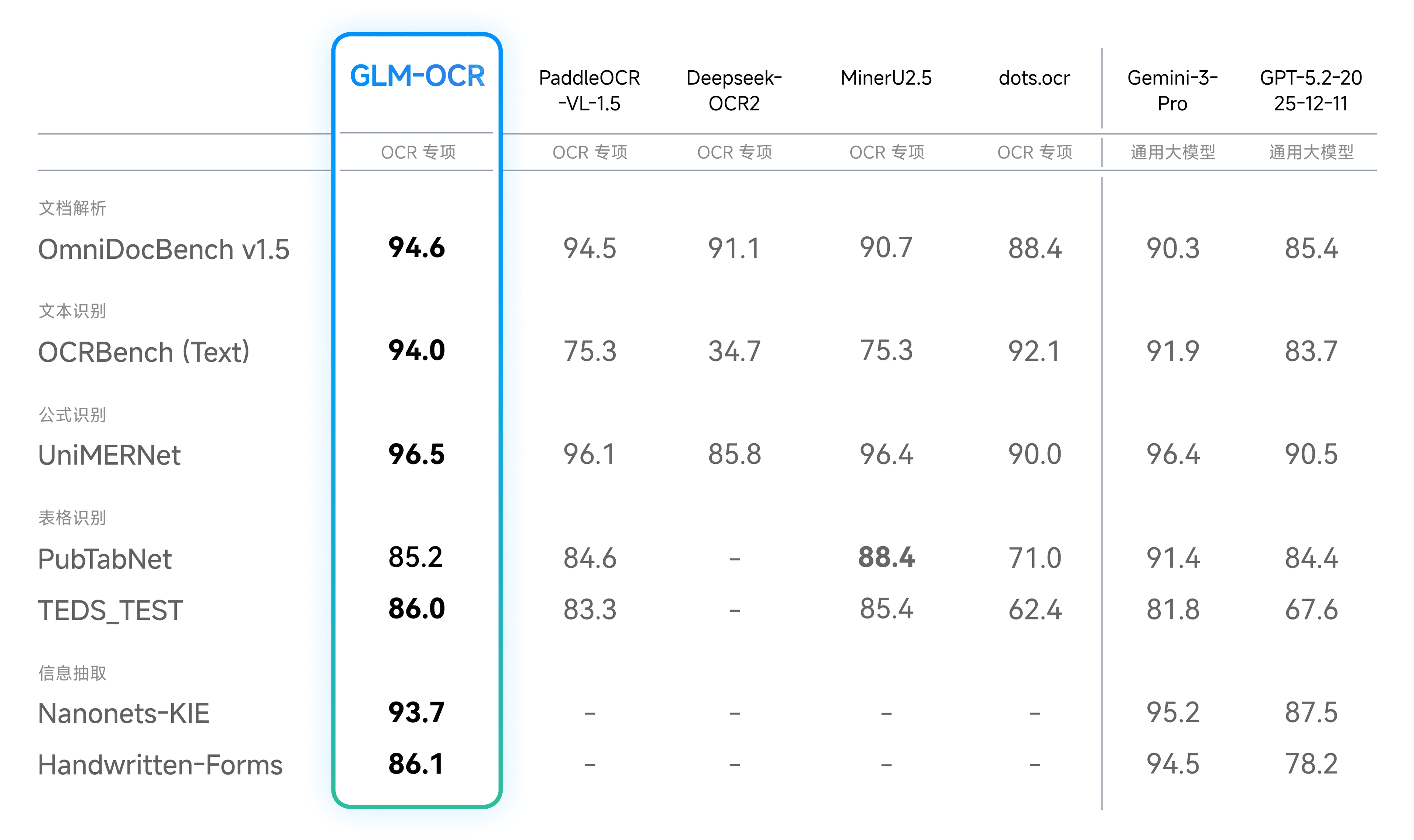
Detailed Benchmark Results
| Category | Benchmark | GLM-OCR | Best Competitor |
|---|---|---|---|
| Document Parsing | OmniDocBench v1.5 | 94.6 | 94.5 (PaddleOCR) |
| Text Recognition | OCRBench (Text) | 94.0 | 92.1 (dots.ocr) |
| Formula Recognition | UniMERNet | 96.5 | 96.4 (MinerU2.5) |
| Table Recognition | PubTabNet | 85.2 | 88.4 (MinerU2.5) |
| Table Recognition | TEDS_TEST | 86.0 | 85.4 (MinerU2.5) |
| Information Extraction | Nanonets-KIE | 93.7 | - |
| Information Extraction | Handwritten-Forms | 86.1 | - |
Key Observations:
- GLM-OCR achieves #1 on OmniDocBench v1.5 (94.6) for document parsing
- Leads in text recognition with 94.0 on OCRBench
- Best formula recognition with 96.5 on UniMERNet
- Strong information extraction capabilities (93.7 on Nanonets-KIE)
Supported Languages
GLM-OCR supports 8 languages:
- Chinese
- English
- French
- Spanish
- Russian
- German
- Japanese
- Korean
Input/Output Specifications
Input Modality:
- PDF, Images (JPG, PNG)
- Single image ≤ 10MB, PDF ≤ 50MB
- Maximum support: 100 pages
Output Modality:
- Text
- Image Links
- Markdown Documents
- Structured JSON
Getting Started
Using the API
curl --location --request POST 'https://api.z.ai/api/paas/v4/layout_parsing' \
--header 'Authorization: Bearer your-api-key' \
--header 'Content-Type: application/json' \
--data-raw '{
  "model": "glm-ocr",
  "file": "https://example.com/document.png"
}'
Using Ollama
# Install and run
ollama run glm-ocr

# Text Recognition
ollama run glm-ocr Text Recognition: ./image.png

# Table Recognition
ollama run glm-ocr Table Recognition: ./image.png
Resources
Conclusion
GLM-OCR represents a significant advancement in OCR technology, achieving state-of-the-art performance with a lightweight architecture. Whether you need to process complex tables, mathematical formulas, or multilingual documents, GLM-OCR provides accurate and efficient document parsing at a fraction of the cost of traditional solutions.
Author
Categories
More Posts
GLM-OCR Quick Start: Complete Document Parsing Guide
Learn how to get started with GLM-OCR for document parsing. This guide covers API integration, Ollama local deployment, vLLM, and SGLang deployment options.
Mathematical Formula Recognition: GLM-OCR LaTeX Output Guide
Learn how to use GLM-OCR for high-accuracy mathematical formula recognition with LaTeX output, perfect for academic documents and scientific papers.
GLM-OCR Local Deployment: Ollama vs vLLM vs SGLang
Compare different local deployment options for GLM-OCR including Ollama, vLLM, and SGLang. Learn which option is best for your use case.